The following images are published on the Routledge website for the chapter Crossdrawing and joint mirror drawing in art therapy and museums by Óttarsdóttir, U. G.. The Figures are part of Chapter 22 of the Routledge International Handbook of Art Therapy Practice (pp. 261-274). Editors of the book are Margaret Hills de Zárate, Diane Waller, and Claire Louise Vaculik.
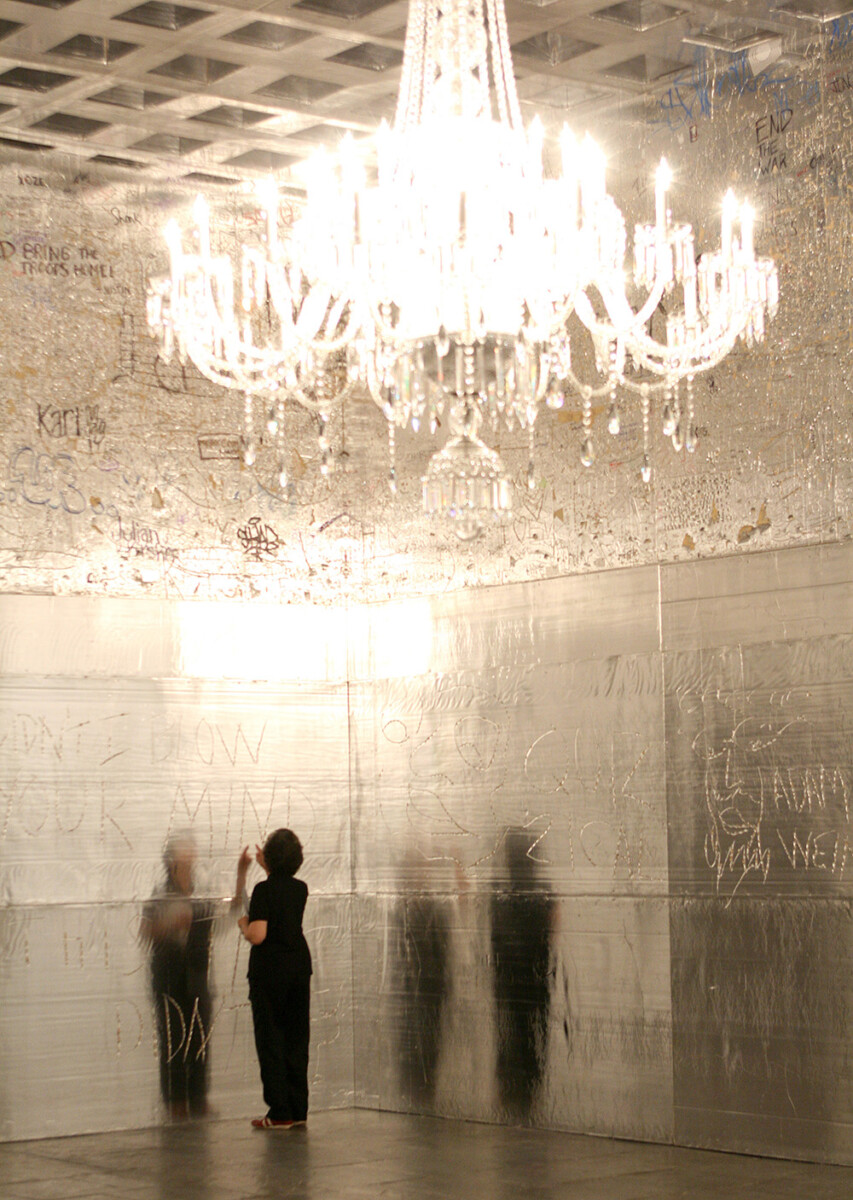
Figure 22.1 Untitled, Stingel (2007). Photo by Julien Jourdes © showing Rudolf Stingel’s wall installation (2007), The New York Times Company. Courtesy of the Whitney Museum of American Art. ALT Text: Person drawing with own objects on aluminium foil within Rudolf Stingel’s wall installation.
Figure 22.2 Scribble-drawing made by a client and the therapist. ALT Text: Felt-pen drawing showing black scribble lines. One of the spaces formed by the scribble is shaded with blue.
Figure 22.3 A drawing made by a client and the therapist. ALT Text: Felt-pen drawing: a purple drawing on the left and a similar orange drawing on the right.
Figure 22.4 Author’s artwork. ALT Text: Four skin-coloured paintings, with gentle marks, placed on a wall. Four square mirrors are positioned on the floor beneath the paintings and each of the mirrors has one of these words: ANDA (e. BREATHE), INN (e. IN), ANDA (e. BREATHE), ÚT (e. OUT).
Figure 22.5 Author’s artwork and paricipants. ALT Text: Some participants in an artwork, sitting with the artist who holds up a piece of A3 paper divided in two halves, where the word “Endurvarp” (e. Reflection) is written normally with a purple felt pen on one part of the paper and upside down on the other part.
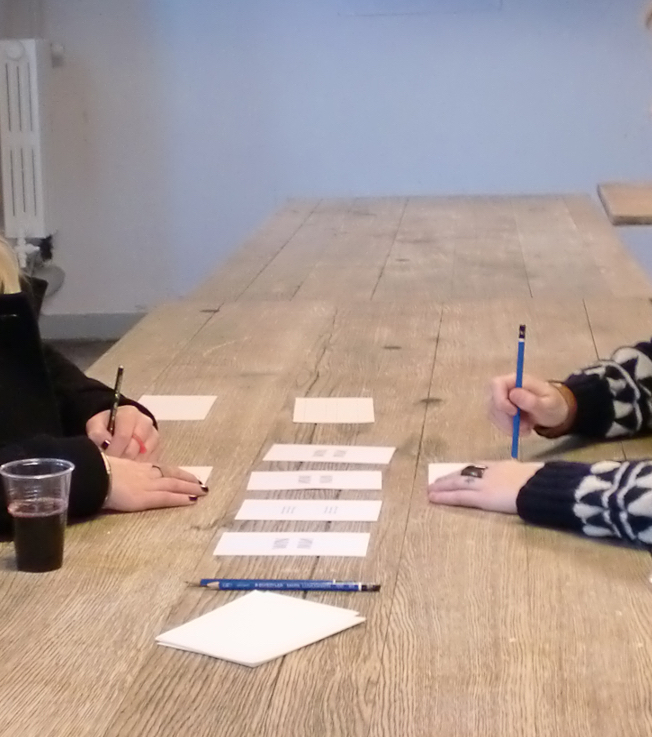
Figure 22.6 Author’s artwork and participants. ALT Text: Two people sit opposite each other at a table and both are drawing. Between them are four cards, pieces of paper and pencils.
Figure 22.7 Reflection (2010) by the author. ALT Text: A cabin made of reflective foil stretched on wood frames which are attached to each other. One of two entrances to the cabin is shown.
Figure 22.8 Participants making a joint mirror drawing in Reflection (2010). ALT Text: Two people standing opposite each other and drawing on a transparent upright board placed between them.
Figure 22.9 Joint mirror drawing on paper made by a client and the therapist. ALT Text: A piece of A3 paper divided into two halves. Similar drawings made with felt pens are located on each side of the image.
Figure 22.10 Participants making a joint mirror drawing on paper. ALT Text: Two people sitting opposite each other and drawing similar images on opposite sides of a piece of A3 paper which is placed on the board between them.
Figure 22.11 Online joint mirror drawing made by a client and the therapist. ALT Text: A drawing divided by a line in the middle, made on whiteboard in Zoom. Similar images have been drawn on opposite sides of the whiteboard.
Figure 22.12 Participant making a crossdrawing. ALT Text: Two pencils are placed in hands that cross, on a drawing with crossing lines.
Figure 22.13 Client’s joint mirror drawing made on a transparent drawing board. ALT Text: A drawing shaded with yellow, made with felt pens on a transparent board. It shows two hearts, one red and the other blue, and also three stars and a house.
Figure 22.14 The difference in how the participants felt before and after the mirror drawing. Bars above zero show findings for participants who felt better. Bars below zero show findings for people who felt worse, while an absence of bars means that people felt the same before and after drawing. ALT Text: Bar chart showing mood changes by numbers presented on the y-axis, either negative (bars below zero), positive (bars above zero) or no mood changes (no bars). Findings for each participant are presented in separate bars and the number located on the x-axis.
Figure 22.15 The difference in how the three participants felt before and after the crossdrawing, which took place in a gallery, an art therapy studio and in a participant’s own art studio. ALT Text: Bar chart showing mood changes by numbers presented on the y-axis: either negative (bars below zero), positive (bars above zero) or no mood changes (no bars). Findings for each participant are presented by separate bars and the number located on the x-axis. The location where the experiment took place is written by each bar.
Óttarsdóttir, U. G. (2025) Joint mirror drawing and crossdrawing in art therapy and museums. In: M. H. de Zárate, D. Waller and C-L. Vaculik (Eds.) (pp 261-274). The Routledge International Handbook of Art Therapy Practice. New York: Routledge.